Showing posts with label #WorldWarII. Show all posts

Wednesday, August 10, 2016

Reluctant History

By Jeff Burns


Recently, on a summer trip to Montana and Wyoming, my wife and I visited the Heart Mountain Japanese Relocation Center historic site.  Located near Cody Wyoming, Heart Mountain was home to about 14,000 Japanese-Americans from the West Coast (and one Caucasian woman who refused to leave her Japanese husband) from 1942 to 1945.  Because of Executive Order 9066 which essentially deemed all Japanese-Americans security risks following the Japanese attack on Pearl Harbor and authorized their relocation to 10 internment camps in some of the most desolate and isolated parts of the country.  Families were forced to sell or give away their farms, stores, and homes.  They were allowed to pack a single suitcase each, loaded on buses and trains and moved to camps like Heart Mountain, where they were to live in hastily built barracks, each family allotted a single small room.  There was no privacy or freedom anywhere, and they were constantly surrounded by barbed wire and armed guards.

Government propaganda photo of life in camp
Candid photo of actual family room

Today, little remains physically of the structures at Heart Mountain. There are a couple of buildings and a smokestack of the hospital complex and a barrack building that has recently been donated and moved back to the site.  None of the buildings are open for visitors.  There is a memorial site and observation posts on top of a hill from which visitors can get a little idea of how the camp was set up. There is an excellent interpretive center with interesting and well done exhibits showing life before Pearl Harbor, the deportations and life in the camp. 

But this is not an “On the Road” Histocrats blog; I’m writing to share an experience at the interpretive center that made me really think about history and the teaching of history. While we were in the museum, a family of three came in: an older Japanese-American man, his Caucasian wife, and their granddaughter who appeared to be in her twenties.  It’s a relatively small museum, so we couldn’t help but overhear their conversation with the museum staff.  Turns out, the man was an internee at Heart Mountain as a small boy, and this was his first visit there since 1945.  The museum staff immediately asked if he wanted to give them his contact information so that his oral history could be added to their collection.  He quietly refused, saying he wasn’t interested.  His wife and granddaughter said that he had never spoken about his experiences, that one of the cultural characteristics of Japanese people is not to dwell on the past, especially unpleasantness, and that had been drilled into him by his family. 

The family followed us into the theater for the excellent film about the camp; the film was produced by the son of an internee and features about a dozen internees telling their stories, including a couple who lived in the same barracks block as the visiting grandfather. Throughout the fifteen minute film and the museum exhibits, I watched the grandfather.  While his granddaughter sobbed during the movie, he sat stoically, without changing expression.  That stoicism persisted as he looked at photographs and exhibits, including reproductions of the rooms.  I could tell that his stoicism frustrated his granddaughter, who obviously wanted him to open up, and his wife, presumably after decades of marriage, appeared to be resigned to his quietness.

When I awoke early the next morning (body clock still on Georgia time), I thought about what I had seen, and I wondered what if I should have introduced myself to the family as a history teacher and told the grandfather how much his story and first person accounts like his mean to my students. Every year, I bring in Vietnam veterans to speak to my classes, and I often share stories of my encounters with Holocaust survivors and civil rights activists.  Their stories bring history to life for my students, and they create more thought, discussion, and reflection than any textbook or lecture can.  However, I know that there is a lot of history within people that they are reluctant to share, so much pain that they can’t bear to speak it. Unfortunately, that grandfather may never be able to share his story, but I developed a deeper appreciation for those who have shared, and I have a renewed desire to use primary sources and personal accounts in my class this fall.

Tuesday, March 22, 2016

Learning about History through a Traveling Military Exhibit

By Margaret Duncan, Ed.D.
Russ Vermillion, Lamar Scott, Buddy Simpson, Marty Potash


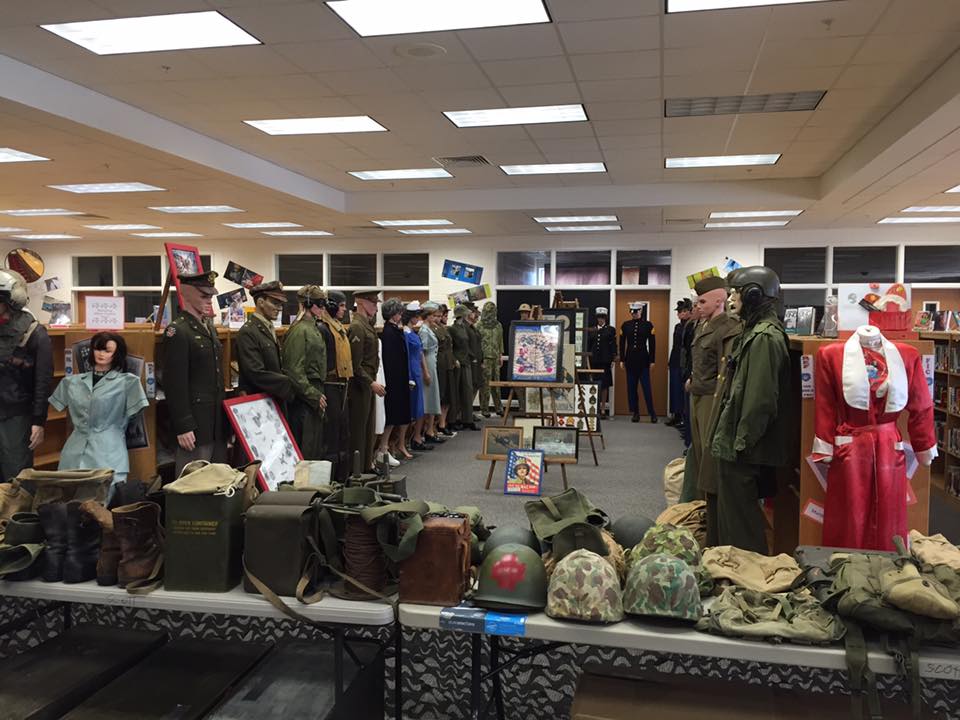
Recently, my school was lucky enough to host a traveling exhibit of historic military items ranging from World War I through Vietnam.  The exhibit contains items from the personal collection of two local Marine Veterans, Buddy Simpson and Lamar Scott.  They have been amassing the collection for over a decade and have been offering it to schools for the last six years, free of charge.  Not only do they set up the exhibit but they, along with fellow Veterans man the exhibit during the day.  Students get to see all the artifacts, and the Veterans are on hand to explain all the items and answer questions.  Plus they often tell stories to go along with the artifacts.


Vietnam Era Items
Picture of Lamar Scott as well as
helmet he wore in Vietnam
For our school, the exhibit was set up in our Media Center and occupied all available space possible.  Originally, we had booked the exhibit for one day, however, scheduling conflicts pushed it to two days.  Once the exhibit was set up, we were grateful for the mix up and happy to have the exhibit longer than originally planned.  The exhibit is so massive it takes a full day for set up and another for take down.  Over the course of two days, all World History and US History students were able to tour it.  However, the exhibit turned out to be so popular that by the second day, Geography and Government students were asking to go.  So, next year the plan is to expand to a full week and even create a community night so that students can bring their families to tour. 


Mannequins clad with uniforms from different eras. 

Mr. Simpson showing students items
 
“I started off with just a little bit of a collection. I went from a few shelves in the bedroom to a 6-by-12-foot trailer. And now we have an 8-by-20-foot trailer,” said Mr. Scott.  Really the collection is much larger than we had expected and the look on our faces when the Veterans first opened the trailer was priceless. However, as we helped unload and set up it was exciting.  Many of us enjoyed looking over the exhibit and holding many of the historical items.  For example, our AP Psychology teacher was able to flip through a book from World War II, Psychology and the Fighting Man.

 
Why amass so many artifacts and create a traveling exhibit?  According to Mr. Simpson, “We do it to teach students about history, if you forget your past, you have no hope for the future. We’re preserving history through wartime collection.” Indeed, student’s reaction to the exhibit was very positive.  For many students, this was the first time they had ever seen so many historical items, military or otherwise. 

For the length of the exhibit, Mr. Scott and Mr. Simpson were joined by fellow Veterans Russ Vermillion (Marines), Terry McClure (Army) and Marty Potash (Air Force).  All of the men volunteer their time helping show off the historic artifacts and engage students with stories and answering questions.  As a teacher, I have known Mr. Vermillion for over a decade as one of my annual Vietnam Veteran speakers. 

Authentic Tuskegee Airmen Uniforms


World War I Uniforms and Saddle
One of the stand out parts of the exhibit was the 56 mannequins on display.  Each mannequin was adorned in antique uniforms.  The uniforms are all authentic and show off the evolution of military dress over time.  One of the most talked about uniforms was the two Tuskeegee uniforms on display.  According to Mr. Scott, “The mannequins represent men and women that died for our freedoms.”

Mr. Simpson and Mr. Scott told us how they regularly receive donations from people who might otherwise toss the historic items in the trash.  Something very sad for a history teacher to hear.  Indeed, there was one photo from WWI that was given to them at a local mall.  The woman said she had planned on throwing it away if they didn’t take it.  Not only did they gladly take the photograph, Mr. Simpson then hand made a wooden oval frame for it to be displayed in. 


Variety of medicines.
World War II German items

The exhibit also contains dozens of cases, hand made by Mr. Simpson containing hundreds of items.  Artifacts ranged from WWI cavalry items to flasks to medical supplies to war medals to money to disabled weapons.  Mr. Scott was able to show off the discontinued miniature cigarette brands and lighters as well as the still-thriving personal hygiene products used in their grandparents’ and great-grandparents’ generations. Other great curiosities included a saddle from WWI, an Army issue portable phonograph player, a typewriter, huge walkie-talkies and the wire and phones from WWI. 

I have told all my teacher friends at other schools all about the exhibit.  It was a wonderful week and I look forward to my school hosting it each year.  It really was exciting to have a mini-museum in our school, if even for just a few days.


Sunday, November 16, 2014

Georgia Humanities Council: Helping Share Part of Everyone's Family Story

By Nina Kendall

As Thanksgiving approaches, we start to think about spending time with family and reminisce about the past.  As we celebrate and give thanks, family and friendships are popular topics. I have yet to attend a holiday or family function that some time was devoted to swapping stories. An important part of being a family is maintaining the stories and traditions that are our individual history.

As history enthusiasts and teachers, we know that not everyone or every family experiences an event the same way.  Our stories are different. Unique and important each one helps to define our community and state. Remembering all the stories becomes the job of not just family members but the community as well. It is a herculean task.

The Georgia Humanities Council helps the people of Georgia connect to all of our stories.   The Georgia Humanities Council is the state affiliate of the National Endowment for the Humanities. Each state has its own affiliate. Here are a few of the stories they will share with citizens of Georgia this year as the end of 2014 approaches.

Standing Together: The Humanities and the Experience of War initiative hosted by the Georgia Humanities Council in conjunction with the Veterans for Community Services to discuss war literature and issues faced by soldiers, past and present.
Dates: November 5, 12, 19; December 3, 10, 17. 
Location: 116 Holiday Ave. NE, Atlanta, 30307

Exploring Muslim Journeys Book discussion will be hosted by The Georgia Humanities Council, One Region Atlanta, and the DeKalb Public Library. This discussion will focus in the books that were part of the Bridging Cultures program supported by the National Endowment for the Humanities.
Date: 6:00 pm - 8:00 pm, November 18
Location: Scott-Candler Library, 1917 Candler Road, Decatur GA 30032

The Bandits & Heroes, Poets & Saints Art Exhibition will be coming to AUC Woodruff Library. This exhibit from Con/Vida-Popular Arts of the Americas will showcase art from Brazil that reflects the intermingling of the Atlantic World over 500 years.                                       
Date: Opens December 1  
Location: AUC Woodruff Library, 111 James P. Brawley Dr. SW, Atlanta, 30314

Over Here and There: Georgia and Georgians in World War II, the exhibit, is on display at the University of West Georgia/Ingram Library, will focus on WWII and the home front.
Date: Closes December 7
Location: University of West Georgia/Ingram Library, 1601 Maple St., Carrollton 30118

Inspired Georgia is the traveling exhibition of 28 works from the state art collection that is currently at its final stop.
Date: Closes December 11, 2014
Location: Historic Train Depot, Kingsland

Have you enjoyed an event hosted by the Georgia Humanities Council?  We would love to hear about it. Not close enough to enjoy one of these events? Check out your local state affiliate and enjoy a story this holiday.